There are few places on Earth that are as divisive as India. At first blush there are aspects of India which many people find alarming, ie it’s uninhibited population growth (it’s the second most populated country in the world, rivalled only by China), it’s patriarchal traditions (some examples include: female dowries, whilst illegal since 1961, still exist as the law is almost impossible to enforce – which perpetuate the idea that women are a liability; men’s more valued status in society – they are deemed to be more worthy of education, healthcare, respect – the sex ratio at birth is skewed in favour of men and female infanticide persists; child marriages – 40% of the world’s child marriages occur in India – support and bolster the idea that females are a burden), the caste system which operates as a system of social stratification, its insular and ostracising policies against international companies operating in India (there are strict protectionist laws in India that only allow Indian citizens to practise law in the country).
Having said all of the above, India is also the world’s largest democracy. It boasts of one of the most colourful cultures in the world and has the third largest higher education system in the world, after China and the US. There is a lot to be proud of.
Before I had even stepped foot in India people told me I would be heartbroken by what I would see but also struck by the beauty and power of the indelible human spirit in the face of adversity. I can now confirm that visiting India was one of the best decisions I ever made and I can highly recommend it to anyone wanting an adventure. India is astounding in so many ways – its culture, history, landscape, and people marry in a colourful cataclysm which has left an imprint on me forever.
Rajasthan was the first stop on my India itinerary. Before I visited Rajasthan it evoked in my mind an image of dusty grandeur – and it certainly didn’t disappoint. I did of course have a moment of madness (read: honesty) when I considered calling this post “the diarrhoea diaries” but sanity prevailed! Though a word of warning: those with a delicate constitution – actually, scrap that, anyone really without a cast iron stomach – should stock up on the old diarolyte… mark my words: you will need it no matter how careful you are!!!!
First stop Delhi.. and let’s just say, there is good reason for its eponymity as regards the famed intestinal complaint?!
SUMMARY
In brief, on the first leg of our trip we travelled from Delhi – Agra – Jaipur – Udaipur – back to Delhi.
Day by Day
Day 1 plan: arrive in Delhi from London – go straight to Agra. Day 2: Agra
We had planned on getting a train from Delhi to Agra five hours after landing but we missed our train due to flight delays. As unsuspecting (read: stupid) tourists we were told by a “guard” outside the train station that there were no other trains going to Agra so we were lead to a “government office” where we hired a cab and “english” guide to take us to Agra. Let’s just say we were conned out of a substantial amount of money before being unceremoniously dumped in the middle of Agra. Enter centre-right of stage a kindly tuk tuk driver who, selflessly, took us around more marble shops in the area than you could shake a stick at, before eventually driving us to our hotel. Lesson number 1: trust no one!
The following day we woke up before sunrise to watch the sun rising over the Taj Mahal. I remember reading about the Taj Mahal when I was 14 and it gripped my imagination: the story of a Moghul emperor building a monument to house his beloved wife in the afterlife – the world’s most striking momento mori. A building so exquisite and memorable that it would stand as one of the wonders of the world almost 400 years later.
The Taj Mahal sits incongruously in Agra – as the world has developed around it, it sits on its own dais, on the banks of the Yamuna River, suspended in a moment of time. It is beautiful by conventional standards, its symmetry and its fairytale-like bulbous histrionic domes all contribute to its delicate perfection, but for me, there is something else which makes this building so different to anything else I’ve ever seen.
It’s partly the love story behind it: it took the Shah around 20 years to build, and has become the sempiternal symbol of his unfaltering love and devotion to the wife who never left his side. But the Taj Mahal also serves as a reminder of the transience of life and the human cost of the emperor’s passion and ephemeral happiness. The less palatable darker aftermath of the Taj Mahal resulted in the emperor being imprisoned in Agra Fort by his own son.
We first saw the Taj Mahal at sunrise – which I would highly recommend. As the Sun rises it burns off the low lying clouds of water vapour which initially shroud the Taj Mahal. It slowly comes into focus as if emerging from the inside of a cloud. The marble, sandstone and jewels reflect the light so it glimmers unapologetically against the pastel blue skies.
Fortunately, some years ago the government brought in a prohibition preventing cars from driving within a 500 metre radius of the Taj Mahal as the pollution was turning it yellow. I wasn’t too impressed by Agra itself. We moved on to Jaipur the morning after Agra on day 3.
Transport and Hotel
We had planned on getting a train from Delhi to Agra (I booked all our train tickets via IRCTC https://www.irctc.co.in/eticketing/loginHome.jsf – it seems a tad complicated but once you’ve set up an account with them – it directs you to the “plan my journey” page and shows you all available trains on a particular date/time). The main train station in Delhi is the New Delhi Railway Station (NDLS) and the main train station in Agra is the Agra Cantonment (AGC). The train takes about three hours – although from 5 April 2016 a new high speed train route was opened up which takes about 1 hour 40 minutes (12050 Gatimaan Express)
We stayed in The Grand Imperial, which was well located, clean and comfortable.


Day 3 and 4 – Explore Jaipur
Jaipur is such a wonderful city – it’s also known as the Pink City because it was painted pink to impress the Prince of Wales when he visited in 1876 (I was told this was to enhance its colour since it was naturally constructed from pink stone). Residents have to maintain the pink colour to this day. It’s in the middle of the Thar desert so it is arid; however, we were there during the monsoon season meaning it was humid as well – an interesting mix. My body went into shock and I was sweating about 4 buckets of water a day.
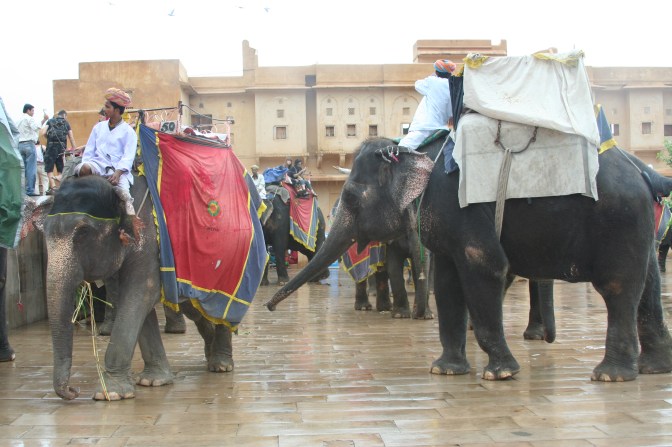
We met a lovely guide whilst in Jaipur who showed us some interesting sights, including the Amber Fort, which is an impressive fort overlooking Jaipur, perched on the side of a mountain. It had spectacular views of the city.
It was also in Jaipur that I experienced my first Indian spice market – and what a curious experience it was! The Sun’s rays heat up the enormous trays of spices in the market, resulting in the smell of hundreds of spices permeating the air and intermingling in the walkways between the various stalls. The assault on the senses takes your breath away. It’s both appalling and fascinating all at the same time.
Jaipur is a shopping mecca – if you want to pick up presents for loved ones or treat yourself – this is the place. You can pick up some lovely pashminas for a good price (note – you get what you pay for! If you want a good quality pashmina, you will still have to pay for it – but it will be much cheaper than its comparator back home).
We moved on from Jaipur on day 4 and took the overnight train to Udaipur.
Transport and Hotel
The train between Agra and Jaipur took approximately 5 hours.
We stayed in the Umaid Mahal – which I can recommend. The food was good (we had bed and breakfast), and whilst being basic, it was comfortable and well located. Unfortunately I had a few camera issues in Jaipur so I don’t have any photos of the hotel – TripAdvisor has lots though – click here (https://www.tripadvisor.co.uk/Hotel_Review-g304555-d607867-Reviews-Umaid_Mahal-Jaipur_Rajasthan.html)
I couldn’t recommend our guide in Rajasthan highly enough – his english was excellent, his car was air conditioned (essential!!!) and comfortable, and his knowledge of the history of the area was extensive. His tour company is: Bahti Tours (http://bhatitours.com/jaipur-day-tour)
Day 5 and 6 – Udaipur
We spent day 5 exploring Udaipur, including Lake Pichola and the City Palace, and went to a traditional dance show in the evening (at Bagore-ki-Haveli, which is on the waterfront at Lake Pichola) followed by a meal at a lovely restaurant overlooking Lake Pichola. I would recommend taking the cable car, Mansapurna Karni Mata Ropeway, as it has spectacular views of Udaipur.
My sister was ill that evening and spent most the night in the toilet (!). I took her to a hospital (the private Aravali Hospital) on day 6 where the doctors diagnosed her with dysentery. We stayed in hospital for 3 hours and she received antibiotics intravenously. She was feeling much better after the antibiotics and we took the train at 5pm that evening.
A side note on Aravali Hospital – before travelling to India, a friend had bought me a compact medical emergency bag containing sterilised syringes and needles (perhaps she knew something I did not!). Despite being a private hospital, which I understood were markedly better than state run ones, I was appalled by the basic standards of hygiene – and when a doctor produced a needle which he intended to insert into my sister’s arm, and which I hadn’t seen him unwrap from a sterilised container, I was eternally grateful for the medical pack! We used one of the needles in it and, if nothing else, it was peace of mind.
Transport and Hotel
We took the overnight train between Jaipur and Udaipur – it took approximately 8 hours. If you are booking the train, ensure you book “sleeper class” so that you get a bed – unless you want to spend the train journey bolt upright!
We stayed in the Mandiram Palace in Udaipur – (https://www.tripadvisor.co.uk/Hotel_Review-g297672-d1005322-Reviews-Hotel_Mandiram_Palace-Udaipur_Rajasthan.html). It was nothing to write home about but clean and well placed for sightseeing.

Day 7 – Back in Delhi
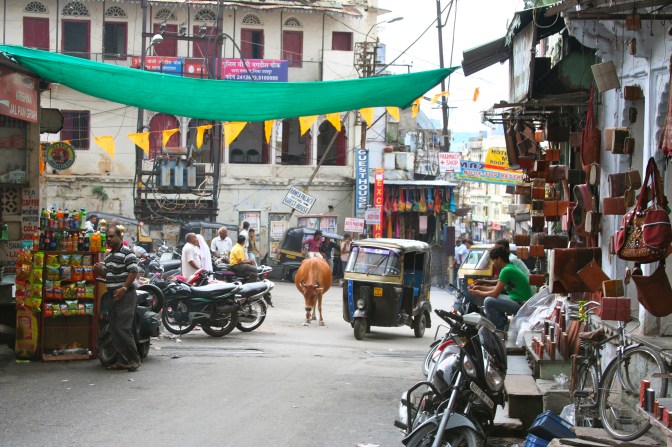
We arrived in Delhi on day 7 and checked into a hotel to sleep and shower for a few hours (we didn’t get much sleep on the train… I suffered from motion sickness and my sister was recovering from dysentry so we mainly ate crisps for 8 hours and drank chai). We then went out to explore Delhi. But how to describe Delhi in a sentence or two? Delhi is, to put it mildly, the most frenetic place I have ever been. It is not just energetic – it is energetic on speed. It’s always humid and hot in Delhi but the heat seems to derive from an inmate property of Delhi itself – almost as though Delhi itself is exothermic. Of course when we arrived in Delhi on our first day, that was a baptism of fire, but I thought we would learn to understand its ways after acclimatising in Rajasthan – we would be less likely to be conned, less likely to be taken for a ride and buy into its maniacal ways. Wrong! Five minutes within a street market, and I was telling myself that my life depended on buying some home-made Indian sandals (that fell apart within 24 hours of wearing them at home). Such is life. Delhi is a melting-pot of religions and cultures: it is a microcosm of the differences found throughout Delhi. Delhi always aspires to be so much more than she is. She is ahead of her time – thinking about the future but embedded in a restrictive past.
That evening we took the night train to Amritsar…
Transport and Hotel
We booked an overnight train from Udaipur to Delhi – this took approximately 12 hours.
*********************************

 addictiontochai.com